Pain
There may be some pain associated with beginning your rehabilitation exercises. If so, speak with your rehabilitation professional or doctor about taking pain medication 20 to 30 minutes before performing your exercises. This is also an important time to focus on the guided imagery exercises specifically designed to help you reduce and manage your pain. Performing some of these exercises at the same time as engaging your body physically in rehabilitation exercises can boost the effectiveness of the guided imagery. If the exercises create pain that is progressive and increasing, your regimen may need to be modified. Confusion about interpreting your pain—whether to work through it or to stop the exercise immediately—is common.
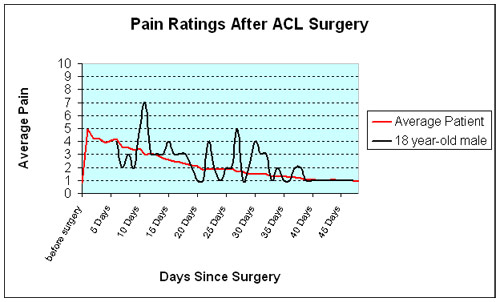
It is important to raise issues such as these with your rehabilitation professional. Learning to relax as you do stretches for your knee, for example, will enable you to not only minimize pain or discomfort, but also allow you to gain maximum benefit from your rehabilitation. As shown in the graphs below, pain varies extensively across individuals over the early stages of rehabilitation. Some people’s pain goes away quickly, whereas other people’s pain lingers for a longer period of time before diminishing. Still other people’s pain fluctuates widely depending on their levels of physical activity and life stress. For the most part, however, the graphs below illustrate how quickly and completely the average patient’s pain is likely to subside.